Sujatha Mohan Throat Issue: Five Years of Silence and the Voice India Has Been Waiting to Hear Again

Sujatha Mohan, the playback singer whose voice shaped five decades of South Indian cinema, has been unable to sing for five years due to a severe throat disorder that, according to MSN’s reporting, also affected her speech. She made this revelation at an awards ceremony in early 2026, and the news sent ripples through an industry that grew up on her voice.
The announcement was quiet, almost understated, for someone whose name appears on more than 18,000 recorded songs. No press release. No dramatic statement. Just a veteran singer explaining, at a gathering meant to celebrate her, that the gift everyone came to honor had been taken from her.
The Revelation That Stunned the Industry
At a music awards event in 2026, Sujatha Mohan told the audience that a throat disorder had been preventing her from singing for five full years, as reported by the Times of India. The condition had been severe enough to stop professional recording sessions entirely. Loss of pitch control and vocal strain had made it impossible to take on any singing assignments during that period.
Fans who had been wondering about her absence from recent film soundtracks finally had an answer. For years, Sujatha Mohan had simply disappeared from credits, and discussions around the Sujatha Mohan throat issue had remained speculative until this moment. The silence had its own explanation, and it was one no one had expected.
The reaction was immediate. Social media filled with messages from musicians, directors, and listeners who had grown up with her songs. Among the most widely shared responses was a video from A. R. Reihana, sister of composer A. R. Rahman, who addressed the camera with visible emotion. Reihana spoke of the depth of her family’s affection for Sujatha, recalling that she had sung the first chorus of a song alongside her and that her mother, had she been alive, would have prayed for her recovery. Reihana made a direct appeal to doctors watching the video, asking them to step forward and help restore one of the most recognizable voices in Indian music.
That a member of the Rahman family, whose musical legacy intersects so closely with Sujatha Mohan’s own career, would publicly call for medical intervention spoke to how seriously the situation was being taken.
What Causes Throat Disorders in Professional Singers
Professional singers face vocal health challenges that most people never encounter, because their instrument is biological, irreplaceable, and under near-constant professional strain. A throat disorder that affects pitch control and speech in a singer of Sujatha Mohan’s career length typically points to one of several conditions, each with its own prognosis.
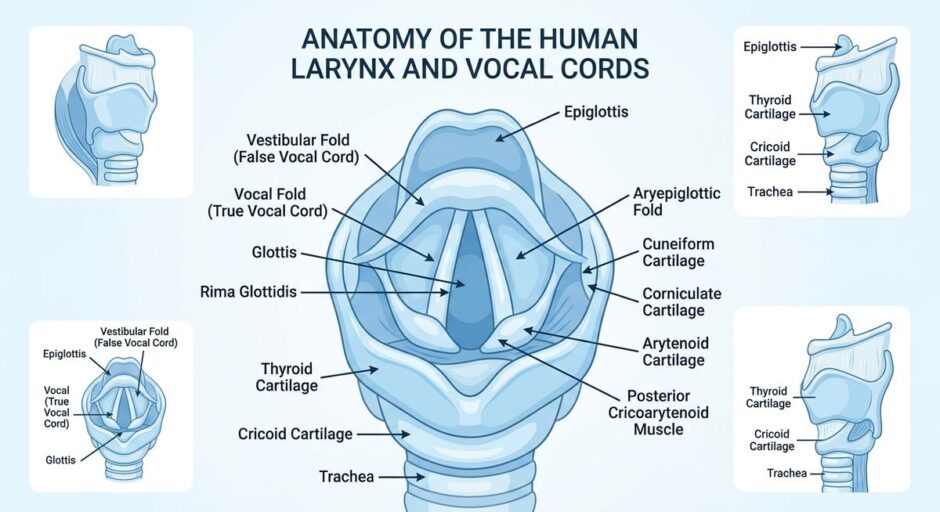
Vocal cord nodules are among the most common causes of persistent voice loss in professional singers, according to Mayo Clinic. These are callus-like growths that form on the edges of the vocal cords due to repeated strain, and they interfere with the precise vibration required for accurate pitch. Polyps, similar in origin but often larger, can appear after a single traumatic vocal event and produce hoarseness, breathiness, or a noticeable drop in vocal range. Both conditions are treatable, typically through voice therapy and sometimes microsurgery, but recovery requires extended rest and professional rehabilitation.
Laryngitis that becomes chronic is another possibility when a singer has been under long-term strain. Gastroesophageal reflux, which many professional singers develop due to touring schedules and dietary irregularity, can cause acid to reach the larynx and produce chronic inflammation. Muscle tension dysphonia, a functional disorder where the muscles surrounding the larynx contract in abnormal patterns, can develop as a response to earlier vocal injury and become self-sustaining even after the original problem has resolved.
| Condition | Primary Symptom | Common in Singers | Treatment Approach |
|---|---|---|---|
| Vocal Cord Nodules | Hoarseness, pitch loss | Yes, especially high-volume recording careers | Voice therapy, rest, occasionally microsurgery |
| Vocal Polyps | Breathiness, voice breaks | Yes | Surgical removal, followed by rehabilitation |
| Laryngeal Reflux | Chronic throat clearing, loss of high register | Common | Dietary changes, medication, voice rest |
| Muscle Tension Dysphonia | Strained, effortful voice | Often secondary to other conditions | Specialized voice therapy |
| Vocal Hemorrhage | Sudden voice loss | Can follow overuse or strain | Strict voice rest, possible surgery |
The specific diagnosis behind the Sujatha Mohan throat issue has not been publicly confirmed by medical professionals. What the singer described at the award event, a throat problem severe enough to stop singing for five years and to affect speech, is consistent with the more serious end of this spectrum.
Five Years Without a Song: The Career Impact
Five years of absence from recording has meant hundreds of missing contributions across the Tamil, Telugu, and Malayalam film industries for a singer who had, by 2025, accumulated a catalog of over 18,000 songs. For Sujatha Mohan, this is not a marginal gap but a near-total pause from the medium she has worked in since childhood.
To understand what five years of vocal absence means for a singer like Sujatha Mohan, the career context is necessary. She began recording as a child, sung alongside K. J. Yesudas in international stage shows as a schoolgirl, and by the time she delivered “Pudhu Vellai Mazhai” for Mani Ratnam’s Roja in 1992 under A. R. Rahman’s direction, she had already been a working professional for over a decade. The song became one of the defining recordings of that era.
By 2025, her catalog had crossed 18,000 songs across Tamil, Telugu, Malayalam, Hindi, Kannada, and several other languages, according to Wikipedia, with more recent reports citing the figure at over 20,000 songs. The songs were not peripheral contributions but central recordings. She was the voice behind “Nenjukkul Peidhidum” from Vinnaithaandi Varuvaayaa, “Malargale Malargale” from Minsara Kanavu, and dozens of other pieces that defined career highs for major directors and composers.
Five years in the career of a playback singer of this standing means hundreds of projects that would have sought her voice and found silence. It means younger voices filling gaps, newer sonic identities attaching to films she might have otherwise colored differently. The industry moves fast. Film soundtracks are completed in weeks. Five years is long enough for an entire generation of films to pass.
From 2021 to 2026, her absence from new recordings was not officially announced, which meant fans speculating, asking at events, getting no clear answer. The revelation at the 2026 award ceremony was the first public confirmation of what had been happening behind the silence.
Sujatha Mohan received the Kalaimamani Award from the Tamil Nadu government in 2021 (for the year 2019), and the SIIMA Award for Best Female Playback Singer for The Priest in 2022. Both came during the years she was managing the throat condition, which adds its own weight to the timeline.
Reihana’s Emotional Appeal: AR Rahman’s Family Speaks Up
The video that followed Sujatha Mohan’s announcement carried more weight than a typical celebrity solidarity message because of who Reihana is and what she represents in the story of Indian film music.
A. R. Rahman’s family connection to Sujatha Mohan is not simply one of professional courtesy. Reihana pointed to a specific memory, singing the first chorus of a song alongside Sujatha, and described how her late mother had deep affection for the veteran singer. The emotional register of the message, addressed directly to the medical community, was that of someone asking on behalf of something irreplaceable.
Reihana stated, according to reports, that if doctors who watch the video could help Sujatha regain her voice, they would be doing something of genuine significance. She spoke of diligence, creativity, what she had personally learned from Sujatha’s approach to her craft. The appeal was both personal and professional, from one artist’s family to a medical community that she hoped might have answers.
The fact that this video circulated widely across Tamil film media and fan communities reflected something real about Sujatha Mohan’s standing. She had been one of the most frequently recorded voices in South Indian cinema. The people who worked with her know precisely what was lost and how rare it is to find a voice with that particular quality.
“Her voice has a quality that you cannot replace. When you produce a song and you need that particular warmth, that depth with lightness, there are very few people who give you that.”
— Sentiment widely expressed by film music producers and directors following the 2026 announcement
Can Sujatha Mohan Sing Again? What Vocal Rehabilitation Looks Like
Recovery from serious vocal cord disorders in professional singers is possible through structured rehabilitation, including voice therapy, behavioral changes, and in some cases surgical intervention, though outcome depends on diagnosis, age, and treatment adherence.
Recovery from the kind of vocal disorder that causes five years of silence is not guaranteed, but it is not impossible. The history of professional singers who have faced serious vocal conditions includes cases of significant, sometimes complete recovery, and cases where the voice returns in a different form.
According to the National Institute on Deafness and Other Communication Disorders (NIDCD), vocal cord disorders in professional singers are treated through a combination of voice rest, behavioral modification, voice therapy, and in some cases surgical intervention. The outcome depends heavily on the specific diagnosis, the duration of the condition, the singer’s age, and how consistently the treatment protocol is followed.
Voice therapy for professional singers involves working with a speech-language pathologist who specializes in voice. The therapy addresses breathing technique, resonance placement, phonation habits, and the elimination of compensatory patterns that develop when a singer adjusts around pain or dysfunction. This is precise, technical work, and for a singer who has spent five decades developing specific vocal habits, retraining requires patience and sustained effort.
What gives grounds for cautious hope in Sujatha Mohan’s case is the context of Reihana’s appeal, which was framed as a call for professional help rather than a farewell. The implication of the announcement itself, made at an awards ceremony rather than a retirement event, was of someone who had not given up. Reihana’s phrasing about helping her “regain” her voice used active language, not the language of irreversible loss.
Several well-known singers in global music history have returned from vocal surgeries and extended absences. The recovery was rarely a return to the exact voice of before, but rather a voice that had adapted, often finding new qualities while recovering some of what had been lost.
The Legacy of a Voice That Defined Generations
Sujatha Mohan is one of the most prolific and recognizable playback voices in Indian cinema, with a career spanning five decades, recordings in at least seven languages, and over 18,000 songs that include some of the most played tracks in South Indian film history.
Sujatha Mohan was born on 31 March 1963 in Kerala, the granddaughter of Paravoor T. K. Narayana Pillai, the first Chief Minister of the State of Travancore-Cochin after Independence. She began singing publicly as a child with K. J. Yesudas at his international stage shows, performed so consistently that she became known in circles as “Baby Sujatha” before she had a formal professional identity.
Her first film recording, “Kannezhuthy Pottuthottu” composed by M. K. Arjunan for the 1975 Malayalam film Tourist Bungalow, came when she was in the sixth standard, according to her Wikipedia biography. She had been in the music industry longer than most of her contemporaries before she married Dr. V. Krishna Mohan in 1981 and took a years-long break from recording. The comeback in 1988 through Kadathanadan Ambadi and the subsequent hit film Chithram reestablished her in Malayalam cinema with a voice that had matured.
The 1990s produced her most globally recognized work. Rahman’s invitation to record “Pudhu Vellai Mazhai” for Roja (1992) was a cultural moment. The song, which opens with that distinctive rain-and-longing quality her voice carries, became one of the defining recordings of the decade. She continued with Rahman through Pudhiya Mugam, Gentleman, Jeans, and Minsaara Kanavu, building one of the most significant singer-composer partnerships in South Indian film music.
In Kerala, she is called Bhava Gayika, the singer of emotions. In Tamil Nadu, Innisai Kuyil, the nightingale of sweet music. These are not titles given out of politeness. They describe a specific quality in her voice, the ability to carry emotional weight without leaning on volume, to suggest feeling through tone rather than declaration.
Her daughter Shweta Mohan has become a successful playback singer in her own right, particularly in Malayalam cinema, which means the musical lineage continues even as Sujatha herself is away from the recording studio. The industry that her voice helped define has not stopped; it has just been missing one of its most distinctive instruments.
FAQ: Sujatha Mohan Throat Issue
What is Sujatha Mohan’s throat problem?
Sujatha Mohan has a severe throat disorder that caused loss of pitch control and affected her ability to speak normally. The specific medical diagnosis has not been publicly disclosed, but the condition was serious enough to prevent any singing for five years and to interfere with ordinary speech.
How long has Sujatha Mohan been unable to sing?
Sujatha Mohan revealed in 2026 that she had not been able to sing for five years due to her throat condition. She made this announcement at an awards ceremony, which was the first public confirmation of the extended absence from recording.
When did Sujatha Mohan reveal her health issue?
Sujatha Mohan publicly revealed her throat health condition at an awards ceremony in early 2026. The announcement was covered by Times of India and other major Indian entertainment media outlets.
Who is Reihana, and why did she appeal for help for Sujatha Mohan?
Reihana is the sister of composer A. R. Rahman. After Sujatha Mohan’s announcement, Reihana circulated a video making an emotional appeal to doctors to help restore Sujatha’s voice, citing the deep personal and family affection her family has for the veteran singer and the significance of Sujatha’s contributions to music.
How many songs has Sujatha Mohan recorded in her career?
As of 2025, Sujatha Mohan has recorded more than 18,000 songs across Tamil, Telugu, Malayalam, Hindi, Kannada, and other languages over her five-decade career, according to Wikipedia, with some reports citing the figure at over 20,000. She is one of the most prolific playback singers in the history of Indian cinema.
Can Sujatha Mohan recover from her throat disorder?
Recovery from serious vocal cord disorders is possible but not guaranteed and depends on the specific diagnosis, treatment approach, and individual factors. Voice therapy, surgery, and strict rehabilitation protocols have helped professional singers return to recording after significant vocal health crises. Reihana’s 2026 appeal was framed as a call for medical help, suggesting the situation is being approached with the hope of recovery rather than acceptance of permanent silence.
What are Sujatha Mohan’s most famous songs?
“Pudhu Vellai Mazhai” from Roja (1992), composed by A. R. Rahman, is widely considered her most famous recording. Other notable songs include “Nenjukkul Peidhidum” from Vinnaithaandi Varuvaayaa, “Malargale Malargale” from Minsara Kanavu, “Poo Pookum Osai,” and “Kannezhuthy Pottuthottu” from Tourist Bungalow (1975), which was her debut recording as a child singer.
Yes. Her daughter Shweta Mohan is a well-known playback singer, particularly active in Malayalam cinema. Her cousins include singer Radhika Thilak and singer G. Venugopal. The family has deep roots in South Indian music across multiple generations.
Five Decades of Giving, Five Years of Silence
Sujatha Mohan has given more than 18,000 songs to Indian cinema. The five-year stretch of silence that followed that extraordinary output is not the story of a career ending; it is the story of a voice fighting to return. The announcement at the 2026 award ceremony was not a farewell, and Reihana’s medical appeal was not written in the language of finality.
What the moment did was make visible something that had been happening quietly for years. The industry had been missing her without quite naming why. Now it knows, and the hope, expressed by those who have worked with her most closely, is that medicine and time can give back what the years have taken.