Business Transformation: The Complete Guide to Reimagining Your Organization

Less than one-third of business transformations succeed. That’s a sobering statistic from McKinsey & Company, and it raises a critical question: if the failure rate is so high, why do so many organizations still attempt these massive undertakings? The answer is simple. In today’s rapidly changing world, standing still is no longer an option. Transformation isn’t just about survival; it’s about thriving in the face of disruption.
Understanding Business Transformation: Beyond the Buzzword
Business transformation is one of the most overused phrases in the corporate world. But what does it truly mean? At its core, business transformation is a fundamental and holistic reimagining of how an organization operates. It’s not about small tweaks or incremental improvements. It’s about making profound, strategic shifts that affect everything from your business model and technology to your company culture and customer experience.
It’s easy to confuse transformation with related concepts. Change management, for instance, is the set of processes used to manage the people side of any change, whether it’s a small process update or a full-blown transformation. Digital transformation is a subset of business transformation that focuses specifically on leveraging technology to create new or modify existing business processes, culture, and customer experiences. While important, these are just pieces of a much larger puzzle.
True transformation is defined by its scope and depth. It addresses the very foundation of how a company creates value. Think of it as the difference between renovating a room and rebuilding the entire house. Renovation is optimization; rebuilding is transformation. One improves what already exists, while the other creates something entirely new.
| Feature | Business Transformation | Business Optimization |
|---|---|---|
| Goal | Reinvent the business model | Improve existing processes |
| Scope | Holistic and cross-functional | Focused and departmental |
| Pace | Episodic and disruptive | Continuous and incremental |
| Risk | High | Low to moderate |
| Outcome | New value creation | Increased efficiency |
This distinction is crucial. Many leaders believe they are leading a transformation when, in reality, they are only optimizing. While optimization is essential for operational excellence, it won’t save a company whose fundamental business model is becoming obsolete. Transformation is the answer when the ground beneath your feet is shifting, and you need to find new, or build, a new place to stand.
The Four Pillars: Building Blocks of Lasting Change
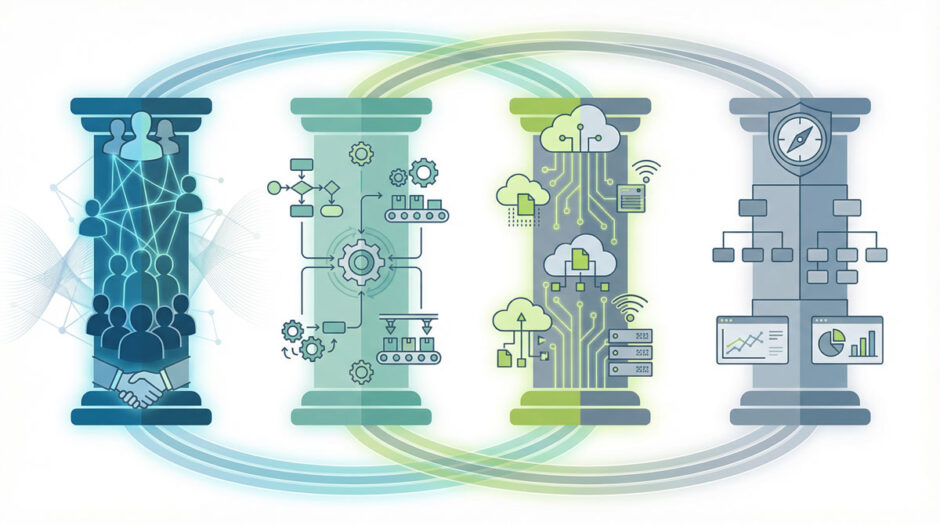
Successful business transformation doesn’t happen by accident. It’s a carefully orchestrated effort that balances four critical pillars. Neglecting any one of these can jeopardize the entire initiative. Think of them as the four legs of a table; if one is weak or missing, the whole structure becomes unstable. True, sustainable change requires a holistic approach that addresses each of these interconnected domains.
People & Culture
This is often the most challenging yet most critical pillar. You can have the best strategy and technology in the world, but if your people aren’t on board, your transformation is doomed to fail. It starts with leadership commitment. Leaders must not only champion the change but also model the desired behaviors. This pillar is about fostering a culture of adaptability, where employees are empowered to experiment, learn, and grow. It requires a significant investment in change management, communication, and training to help people navigate the uncertainty and ambiguity that come with transformation. Ultimately, it’s about winning the hearts and minds of your employees, because they are the ones who will bring your transformation to life.
Processes & Operations
Transformation requires a fundamental rethinking of how work gets done. This pillar focuses on redesigning your core processes and operations to be more agile, efficient, and customer-centric. It’s about breaking down silos, eliminating bottlenecks, and creating seamless workflows that span across departments. Many organizations are adopting agile methodologies to replace rigid, hierarchical structures, allowing them to respond more quickly to market changes. The goal is to create a lean, adaptive organization where continuous improvement is embedded in the DNA. This isn’t just about cutting costs; it’s about creating the operational backbone to support your new business model and deliver superior value to your customers.
Technology & Infrastructure
In today’s digital age, technology is a powerful enabler of business transformation. This pillar involves modernizing your technology and infrastructure to support your strategic goals. This could mean migrating to the cloud, adopting AI and automation, or implementing new digital platforms. However, it’s crucial to remember that technology is a means to an end, not the end itself. The most common mistake is to lead with technology, hoping it will magically solve all your problems. Instead, technology choices should be driven by your business strategy. The right technology, when implemented thoughtfully, can unlock new capabilities, create new revenue streams, and deliver a superior customer experience.
Governance & Strategy
This pillar provides the direction and oversight for your transformation journey. It starts with a clear and compelling vision and strategy. Everyone in the organization needs to understand why the transformation is necessary and what success looks like. Governance provides the structure and processes to manage the transformation, including clear roles and responsibilities, decision-making authority, and a mechanism for tracking progress. A central transformation office (TO), led by a Chief Transformation Officer (CTO), can be highly effective. Finally, this pillar emphasizes data-driven decision-making. You need to establish clear metrics to measure success and use data to make informed choices throughout the transformation process.
| Pillar | Focus | Key Activities | Example |
|---|---|---|---|
| People & Culture | Mindset, skills, and behaviors | Leadership alignment, change management, training | A company invests in reskilling its workforce for new digital roles. |
| Processes & Operations | Workflows and efficiency | Process reengineering, agile adoption, automation | A manufacturer implements lean principles to reduce waste and production time. |
| Technology & Infrastructure | Tools and platforms | Cloud migration, AI implementation, data analytics | A retailer builds an e-commerce platform to create an omnichannel experience. |
| Governance & Strategy | Direction and oversight | Vision setting, establishing a TO, performance tracking | A leadership team defines clear KPIs and holds weekly progress reviews. |
The 5 C’s: Your Roadmap Through Organizational Change
If the four pillars are the what of transformation, the 5 C’s are the how. They provide a practical framework for navigating the human side of change. Transformation inevitably creates uncertainty and anxiety. People are naturally wired to resist change because it disrupts their routines and sense of security. Understanding this psychological barrier is the first step to overcoming it. The 5 C’s offer a roadmap to guide your people through this challenging journey with empathy and purpose.
Clarity
Confusion is the enemy of change. Without clarity, employees will fill the information vacuum with fear and speculation. Leaders must articulate a compelling and unambiguous reason for the transformation. Why are we doing this? What does success look like? How will this affect me and my daily work? These questions need clear, honest answers. This isn’t about a single announcement; it’s about consistent, repetitive communication that reinforces the “why” behind the change, connecting it to a shared purpose.
Communication
Effective communication is a two-way street. It’s not just about broadcasting messages from the top down. It’s about creating a dialogue. Leaders must be transparent about the challenges and uncertainties, not just the exciting vision. Use multiple channels to reach people where they are. Most importantly, create robust feedback loops. Listen to concerns, address rumors, and make people feel heard. This builds trust and helps you identify potential roadblocks before they derail your efforts.
Collaboration
Transformation cannot be dictated from an ivory tower. It requires deep collaboration across all levels of the organization. Break down the silos that stifle innovation and create cross-functional teams to solve problems together. When people are involved in designing the change, they develop a sense of ownership. This shifts their mindset from being passive recipients of change to active participants in shaping the future of the company. Collaboration fosters a sense of shared purpose and collective responsibility.
Culture
Culture is the invisible force that can either accelerate or kill your transformation. You can’t simply mandate a new culture. You have to cultivate it. This means actively shifting mindsets and behaviors. Celebrate the small wins to build momentum. Create psychological safety, where people feel comfortable taking risks and learning from failure. Most importantly, leaders must embody the new culture. Their actions speak louder than any mission statement. A healthy culture is the fertile ground where transformation can take root and flourish.
Commitment
Finally, transformation requires unwavering commitment, especially from leadership. This isn’t a short-term project; it’s a multi-year marathon. Leaders must demonstrate their commitment by allocating the necessary resources—time, money, and talent. They must be visible, actively participating in the transformation and removing obstacles. When the going gets tough, their sustained effort and resilience will inspire the rest of the organization to persevere. Commitment is the glue that holds the entire transformation together.
Transformation in Action: Learning from Industry Leaders
Theory is one thing, but seeing transformation in practice is another. The best way to understand the power and complexity of business transformation is to look at companies that have successfully navigated this journey. These stories are not just about adopting new technology; they are about fundamentally reimagining business models, cultures, and customer relationships. Let’s explore three iconic examples of companies that transformed themselves and reshaped their industries.
Case Study 1: Netflix – From DVDs to Streaming Dominance
Background: In the early 2000s, Netflix was a popular DVD-by-mail rental service. However, its leadership saw the writing on the wall: the future was in digital streaming. Rather than clinging to its profitable but declining business model, Netflix made the bold decision to disrupt itself. This was a risky move, as it meant competing with its own core business.
Transformation Strategy: Netflix’s transformation was a complete business model shift. It invested heavily in building a robust streaming platform and acquiring a vast library of digital content. The pivotal moment came when it began producing its own original content, starting with “House of Cards” in 2013. This transformed Netflix from a content distributor into a global media powerhouse.
Results: The results were staggering. Today, Netflix has over 230 million subscribers worldwide and has completely redefined the entertainment industry. Its willingness to cannibalize its own DVD business in favor of streaming is a masterclass in long-term strategic thinking.
Case Study 2: Domino’s – From Pizza Chain to Tech Giant
Background: A decade ago, Domino’s was struggling. It faced intense competition, and its pizza was the butt of late-night jokes. The company realized it wasn’t just in the pizza business; it was in the pizza delivery business. This insight sparked a radical transformation.
Transformation Strategy: Domino’s reinvented itself as a “tech company that sells pizza.” It invested heavily in its digital ordering platform, creating a seamless customer experience across its website and mobile app. The Domino’s Tracker, which allows customers to follow their pizza’s journey from oven to door, was a game-changer. It also embraced AI for delivery routing and quality control.
Results: The transformation was a resounding success. Domino’s stock price soared, and it became the world’s largest pizza chain. More than half of its sales now come through digital channels. Domino’s proved that even a traditional business could become a digital leader by focusing relentlessly on the customer experience.
Case Study 3: Microsoft – The Cloud-First Revolution
Background: Under its previous leadership, Microsoft was a company tethered to its Windows and Office monopolies. It was slow to adapt to the rise of mobile and cloud computing, and its culture was becoming stagnant. When Satya Nadella took over as CEO in 2014, he initiated one of the most remarkable transformations in corporate history.
Transformation Strategy: Nadella’s vision was to transform Microsoft into a “cloud-first, mobile-first” company. This meant a massive cultural shift from a “know-it-all” to a “learn-it-all” mindset. He de-emphasized Windows and went all-in on Azure, Microsoft’s cloud computing platform. The business model shifted from selling software licenses to selling subscriptions.
Results: The pivot to the cloud was a spectacular success. Azure has become a major force in the cloud market, and Microsoft’s market capitalization has more than tripled. The transformation revitalized the company’s culture, making it a more open, collaborative, and innovative place.
| Company | Transformation Driver | Key Strategic Shift | Financial Impact (Approx.) |
|---|---|---|---|
| Netflix | Technological Disruption | DVD Rental to Streaming & Original Content | Market cap grew from ~$5B to over $200B |
| Domino’s | Poor Customer Perception | Pizza Company to E-commerce/Tech Leader | Stock price increased over 2,000% in a decade |
| Microsoft | Market Shift (Cloud & Mobile) | Desktop Software to Cloud-First Subscriptions | Market cap grew from ~$300B to over $2T |
Why Transformations Fail: Mistakes to Avoid
While the success stories are inspiring, the reality is that most transformations fail to achieve their goals. A study by the Boston Consulting Group found that a staggering 75% of transformation efforts fall short. Understanding the common pitfalls is the first step toward avoiding them. These aren’t just minor missteps; they are fundamental errors in strategy and execution that can unravel even the most well-intentioned efforts. Let’s examine the five most common reasons why transformations fail and how you can steer clear of them.
Pitfall 1: Lack of a Clear Vision
What goes wrong: The leadership team fails to articulate a clear and compelling vision for the transformation. Employees are left confused about the direction and purpose of the change. The “why” is missing, and the initiative feels like another top-down mandate without a clear rationale.
Impact: This leads to wasted effort, as teams work at cross-purposes. Engagement plummets, and a sense of cynicism takes hold. Without a North Star to guide them, people will resist the change or, worse, ignore it altogether.
How to avoid it: The vision must be more than just a slogan. It needs to be a vivid picture of the future state that resonates with everyone in the organization. Communicate it relentlessly through multiple channels, and ensure that every decision aligns with that vision.
Pitfall 2: Underestimating People & Culture
What goes wrong: The transformation is treated as a technology or process project, while the human element is ignored. The focus is on implementing new systems, with little thought given to how people will adapt to new ways of working.
Impact: This is the single biggest reason for failure. Resistance to change becomes widespread. Adoption of new tools and processes is low. The transformation stalls because the underlying mindsets and behaviors haven’t changed.
How to avoid it: Invest as much in change management as you do in technology. Provide training and support. Create a psychologically safe environment where people can voice their concerns. Empower your employees to be part of the solution, not just the target of the change.
Pitfall 3: Unrealistic Timelines
What goes wrong: Leaders expect a complex transformation to happen in a matter of months. They push for quick wins at the expense of sustainable change. The pressure to deliver immediate results leads to shortcuts and burnout.
Impact: The transformation becomes a “flavor of the month” initiative. Employees become fatigued and disillusioned. The changes don’t have time to take root, and the organization quickly reverts to its old ways once the pressure is off.
How to avoid it: Set realistic expectations from the outset. Transformation is a marathon, not a sprint. Break the journey down into manageable phases and celebrate the milestones along the way. This builds momentum and demonstrates progress, which is crucial for maintaining morale.
Pitfall 4: Poor Stakeholder Engagement
What goes wrong: The transformation is planned in isolation by a small group of senior leaders. Key stakeholders—employees, middle managers, and even customers—are excluded from the process. Their insights are ignored, and their concerns are dismissed.
Impact: This creates a sense of alienation and resentment. You face unexpected resistance from the very people you need to implement the change. The transformation plan is flawed because it wasn’t informed by the people on the front lines.
How to avoid it: Involve a diverse group of stakeholders from the very beginning. Create forums for input and feedback. Co-create the transformation plan with the people who will be most affected by it. This builds buy-in and ensures that your plan is grounded in reality.
Pitfall 5: Declaring Victory Too Early
What goes wrong: The organization achieves a few early successes and declares the transformation complete. The focus shifts to the next big thing, and the sustained effort required to embed the change is abandoned.
Impact: The initial gains are quickly lost. The organization regresses to its old habits and processes. The transformation becomes a “false start,” and employees become even more cynical about future change initiatives.
How to avoid it: Understand that transformation is a long-term commitment. The goal is not just to implement new systems but to create a new way of operating. Embed the changes into your organization’s structure, processes, and performance metrics. Continuously monitor and reinforce the new behaviors until they become the new normal.
Beyond the Numbers: How to Measure Real Transformation Success
How do you know if your transformation is working? While financial returns are important, they don’t tell the whole story. True transformation creates value across multiple dimensions. A comprehensive measurement framework should be holistic, balancing financial outcomes with operational improvements, cultural shifts, and strategic gains. This dashboard approach gives you a 360-degree view of your progress and helps you make data-driven decisions to keep your transformation on track.
Financial Metrics
These are the bottom-line results that every executive wants to see. They measure the direct financial impact of your transformation. Key metrics include revenue growth from new products or markets, cost reduction from increased efficiency, and the overall return on investment (ROI) of your transformation initiatives. Tracking these metrics is essential for demonstrating the value of your efforts to the board and investors.
Operational Metrics
These metrics gauge the health of your core processes and operations. They tell you if you are becoming a more efficient and effective organization. Look at metrics like process efficiency (e.g., cycle time reduction), time-to-market for new products, and improvements in quality. Most importantly, track customer satisfaction and Net Promoter Score (NPS). A successful transformation should always lead to a better customer experience.
People & Culture Metrics
These are often considered “soft” metrics, but they are leading indicators of long-term success. They measure the health of your organization and the engagement of your people. Track employee engagement scores, employee retention rates, and the progress of your skills development programs. You can also measure the increase in innovation, such as the number of new ideas generated or the percentage of revenue from new products.
Strategic Metrics
These metrics assess your position in the market and your long-term viability. Are you gaining a competitive advantage? Track your market share relative to your competitors. Measure your brand perception and how it’s changing. Ultimately, the goal of transformation is to achieve long-term sustainable growth. These metrics tell you if you are on the right path.
| Metric Category | Key Performance Indicator (KPI) | Example Measurement |
|---|---|---|
| Financial | Return on Investment (ROI) | 25% ROI within 3 years |
| Revenue Growth (New Products) | 15% year-over-year growth | |
| Operational | Customer Satisfaction (CSAT) | Increase CSAT score from 75% to 90% |
| Process Cycle Time | Reduce order fulfillment time by 50% | |
| People & Culture | Employee Engagement Score | Improve engagement from 65% to 80% |
| Employee Retention Rate | Decrease voluntary turnover by 20% | |
| Strategic | Market Share | Increase market share by 5 percentage points |
| Brand Perception | Improve brand sentiment score by 15% |
Frequently Asked Questions (FAQ)
Here are answers to some of the most common questions about business transformation.
- 1. What’s the difference between business transformation and digital transformation?
- Think of business transformation as the overall strategy and digital transformation as a critical component of that strategy. Business transformation is a holistic overhaul of a company’s model, processes, and culture. Digital transformation is the part of that overhaul that specifically involves adopting digital technology. For example, a company might undergo a business transformation to become more customer-centric. A key part of that would be a digital transformation to implement a new CRM system and an e-commerce platform.
- 2. How long does a business transformation typically take?
- There’s no one-size-fits-all answer, but a true business transformation is a marathon, not a sprint. Most successful transformations take between two to five years to be fully implemented and embedded. The initial phases of planning and design might take 6-12 months, followed by a multi-year rollout. It’s important to set realistic expectations and focus on sustained effort rather than a quick fix.
- 3. What are the 4 R’s of business transformation?
- The 4 R’s provide a simple framework for thinking about the transformation process:
- Reframe: Change how you think about your business and the market.
- Redesign: Redesign your business model, processes, and organization.
- Realign: Realign your people, culture, and incentives with the new design.
- Roll out: Implement the changes and continuously adapt.
- 4. What is a business transformation job?
- A business transformation job involves working on large-scale change initiatives within an organization. Roles can range from a Chief Transformation Officer (CTO), who leads the entire effort, to project managers, change managers, and analysts who work on specific workstreams. These roles require a blend of strategic thinking, project management skills, and strong communication abilities.
- 5. How do you overcome resistance to change?
- Overcoming resistance starts with empathy. Understand that people resist change because of fear of the unknown, loss of control, or perceived threats to their job security. The 5 C’s framework is a great guide: provide Clarity on the “why,” Communicate openly and honestly, foster Collaboration, cultivate a supportive Culture, and demonstrate unwavering Commitment. Involving people in the process and giving them a voice is the most effective way to turn resistance into engagement.
- 6. What’s the role of technology in business transformation?
- Technology is a powerful enabler, but it is not the driver of transformation. The business strategy should always come first. Technology should be chosen to support that strategy, not the other way around. For example, if your strategy is to improve customer experience, you might implement AI-powered chatbots or a new mobile app. The technology serves the strategic goal.
- 7. Can small businesses do transformation?
- Absolutely. Transformation is not just for large corporations. The principles are the same, but the scale and complexity will be different. A small business might transform by shifting from a brick-and-mortar model to an e-commerce-first approach, or by adopting new software to automate its operations. The key is to be agile and willing to rethink your business model in response to market changes.
- 8. How do you ensure transformation changes stick?
- This is one of the biggest challenges. To make changes stick, you need to embed them into the fabric of your organization. This means updating your systems, processes, and performance metrics to reinforce the new way of working. It also requires a sustained focus on culture and behavior. Leaders must continue to model the new behaviors, and the organization must celebrate and reward those who embrace the change. It’s about making the new way of working the new normal.
Conclusion
Business transformation is one of the most challenging endeavors an organization can undertake, but it is also one of the most rewarding. It’s a journey that requires courage, commitment, and a relentless focus on creating value. The path is fraught with challenges, but as we’ve seen from the stories of companies like Netflix, Domino’s, and Microsoft, the rewards can be immense. By understanding the four pillars, embracing the 5 C’s of change management, and learning from the mistakes of others, you can significantly increase your chances of success.
Transformation is not a one-time event; it’s a continuous process of adaptation and renewal. In a world of constant disruption, the ability to transform is the ultimate competitive advantage. The journey may be long, but it begins with a single step. Start today by asking yourself: What is the future we want to create for our organization? And what is the first step we can take to get there?


