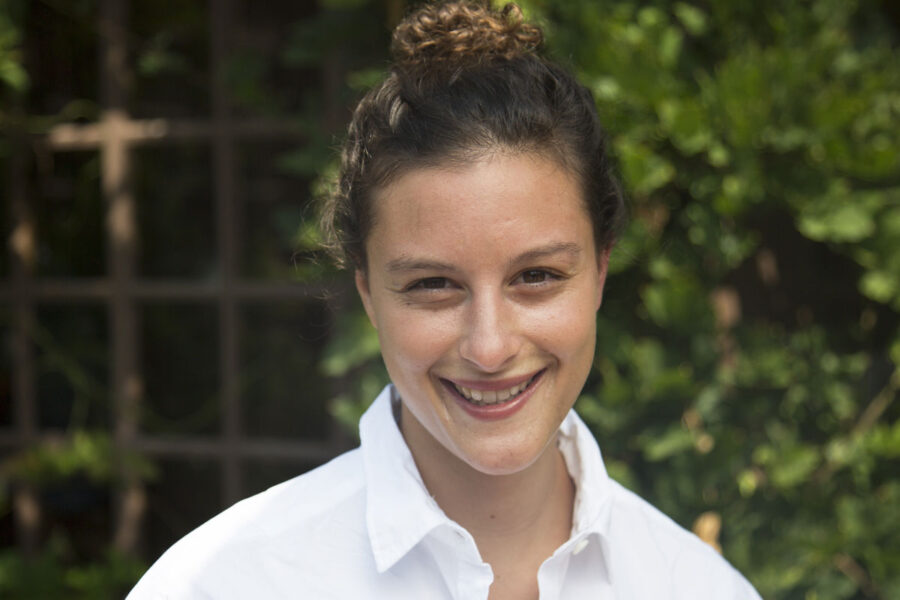
Sara Harrison: Award-Winning Science Journalist and Educator
In June 2019, a feature article about the science of smell appeared in WIRED magazine. It wasn’t just another science story. The piece, written by Sara Harrison, captured something that most readers didn’t know they were missing: a profound exploration of how humans perceive the world through their noses, and how scientists were racing to teach machines to smell. The article was so compelling, so meticulously researched, and so beautifully written that it earned inclusion in The Best American Science and Nature Writing 2020—a distinction that places it among the finest science journalism published in North America that year. For many readers, it was their introduction to Sara Harrison. For those in the journalism world, it confirmed what editors and peers already knew: here was a writer who could make complex science not just understandable, but genuinely captivating.
The Making of a Science Journalist: Education and Early Career

Sara Harrison’s path to becoming a science journalist wasn’t a straight line. She didn’t grow up dreaming of writing about laboratory discoveries or technological breakthroughs. Instead, her journey reflects a more organic evolution—one that began with a love of language and storytelling, and gradually expanded to encompass the scientific world. Understanding how she got here reveals something important about contemporary science journalism: the best science writers often come from humanities backgrounds, bringing literary sensibilities to technical subjects.
Carleton College and the Foundation in English
Harrison’s undergraduate education at Carleton College in Minnesota provided the foundation for everything that would follow. She majored in English, a choice that might seem distant from science writing at first glance. Yet this decision proved crucial. While her peers in science programs were learning the technical details of their disciplines, Harrison was learning something equally valuable: how to read deeply, think critically, and express complex ideas with clarity and elegance. English majors who become science journalists often bring a particular strength to their work—they understand that the best writing isn’t just about conveying information, it’s about creating an experience for the reader. They know how to structure a narrative, develop a voice, and make abstract concepts feel concrete and relevant.
Carleton, a selective liberal arts college known for its rigorous academics and emphasis on critical thinking, reinforced these skills. The college’s approach to education—focused on deep learning rather than specialization—aligned perfectly with what Harrison would later discover about science journalism: the ability to learn quickly about unfamiliar topics, ask good questions, and synthesize information from multiple sources matters more than prior expertise in any particular scientific field.
The Decision to Pursue Journalism
After graduating from Carleton, Harrison made a deliberate choice: she would pursue journalism. This was a significant decision, one that required her to acquire new skills and enter a profession that was already undergoing dramatic transformation in the early 2010s. The internet was reshaping how news was gathered, reported, and consumed. Print publications were struggling. The traditional career path for journalists—starting at a local newspaper, building experience, and gradually moving to larger outlets—was becoming less reliable. Yet Harrison chose this moment to enter the field, which speaks to her commitment to the profession and her confidence in her abilities.
UC Berkeley Graduate School of Journalism
In 2017, Harrison enrolled in the UC Berkeley Graduate School of Journalism, one of the nation’s most prestigious journalism programs. Berkeley’s program is known for its rigorous training and its emphasis on producing journalists who can work across multiple platforms and formats. The program attracts talented students from around the country and the world, creating an intensely competitive and intellectually stimulating environment. For Harrison, Berkeley was transformative. It was here that she would refine her craft, develop her voice as a writer, and begin building the professional network that would support her career.
During her time at Berkeley, Harrison distinguished herself as an exceptional student. She was named a Dean’s Merit Fellow, an honor given to students who demonstrate outstanding academic achievement and potential. This recognition wasn’t merely ceremonial—it came with financial support and, more importantly, with validation from the faculty that she had something special to offer the field of journalism. Her professors recognized in her the qualities that would define her career: intellectual curiosity, meticulous attention to detail, and an ability to find compelling human stories within complex subjects.
The Clay Felker Award for Excellence in Narrative Writing
In 2019, upon completing her degree, Harrison received the Clay Felker Award for Excellence in Narrative Writing. This award, given annually to one graduating student, recognizes exceptional achievement in narrative journalism—the art of telling true stories with literary flair. The award is named after Clay Felker, the legendary editor who founded New York Magazine and helped define modern magazine journalism. That Harrison received this award in the same year her WIRED article about the science of smell was published is not coincidental. By 2019, she had already begun to demonstrate the qualities that would define her career: the ability to take a scientific subject and craft it into a narrative that engaged readers emotionally while maintaining rigorous accuracy.
The Clay Felker Award represented more than just recognition of past achievement. It was a signal to the journalism world that here was a writer worth paying attention to. It opened doors, built credibility, and gave Harrison the confidence to pursue her ambitions in a profession that can be uncertain and financially precarious, especially for freelancers.
Early Career at Los Angeles Review of Books
Before completing her degree at Berkeley, Harrison had already begun her professional journalism career. She worked as an assistant editor for the politics section of the Los Angeles Review of Books (LARB), a prestigious online publication known for its long-form cultural and political criticism. This position, while not focused on science, was invaluable for her development as a journalist. At LARB, she learned how to edit other writers’ work, understand what makes a story compelling, and navigate the editorial process. She also began publishing her own work, building the portfolio that would attract editors at larger publications.
Working in the politics section of a literary publication taught Harrison something crucial about journalism: the best writing, regardless of subject matter, shares certain qualities. It’s specific rather than general. It’s grounded in reporting and research. It respects the reader’s intelligence. It acknowledges complexity rather than reducing issues to simple narratives. These lessons, learned in the context of political and cultural writing, would later inform her approach to science journalism.
The Foundation Set
By the time Harrison completed her master’s degree in 2019, she had already established herself as a promising young journalist. She had institutional recognition (the Clay Felker Award), professional experience (her work at LARB), and a growing portfolio of published work. She had also demonstrated the qualities that would define her career: intellectual rigor, narrative skill, and an ability to make complex subjects accessible. The foundation was set. What remained was to build on it—to establish herself as a freelance journalist, to develop expertise in science writing, and to create work that would resonate with readers and earn recognition from her peers.
Breaking Through: From LA Review of Books to Major Publications
The Transition to Freelance
The leap from staff positions at publications like the Los Angeles Review of Books to full-time freelance journalism is a significant one. For many writers, it’s a leap of faith. There’s no guaranteed paycheck, no health insurance, no institutional support. Yet for Sara Harrison, this transition made sense. By 2019, she had already begun publishing in major outlets. She had won significant awards. She had developed a distinctive voice. The timing was right to commit fully to freelance work, pursuing the stories that interested her and building relationships with editors at publications where she wanted to see her work appear.
Freelance journalism, particularly in science writing, requires a particular set of skills beyond the ability to write well. It requires entrepreneurial thinking—the ability to pitch ideas to editors, manage multiple projects simultaneously, and maintain relationships with publications and sources. It requires financial discipline, since income is irregular. And it requires a certain kind of resilience, because rejection is frequent and inevitable. Harrison’s background—her education at elite institutions, her early professional success, her award recognition—provided a foundation. But what really matters is what she did with these advantages: she worked hard, she stayed curious, and she continued to develop her craft.
Building Relationships with Major Publications
One of the most important aspects of freelance journalism is building relationships with editors at publications where you want to publish. These relationships are built through consistent, high-quality work; through responsiveness and professionalism; and through the ability to understand what a particular publication is looking for and deliver it. Harrison excelled at this. Within a few years of beginning her freelance career, her byline appeared in some of the most prestigious publications in the country.
WIRED magazine became one of her primary outlets. WIRED, owned by Condé Nast, is known for its coverage of technology, science, and culture. It’s a publication that reaches millions of readers and has significant cultural influence. Getting published in WIRED is a major achievement for any journalist, but particularly for a freelancer. It requires editors to trust that you can deliver a story that meets their standards and their readers’ expectations. Harrison’s early work for WIRED impressed editors enough that she became a regular contributor, eventually serving as a reporting fellow at the publication—a position that gave her more stability and deeper access to editorial resources while she continued to develop her craft.
Beyond WIRED, Harrison’s work appeared in New York Magazine, Discover, Scientific American, The Cut, and numerous other publications. Each of these outlets has its own editorial voice, its own audience, its own expectations. The fact that Harrison’s work appeared in all of them speaks to her versatility and her ability to adapt her writing to different contexts while maintaining her distinctive voice. A story about cryptocurrency for New York Magazine requires a different tone and structure than a story about Alzheimer’s research for Scientific American, yet both need to be accurate, engaging, and well-reported.
The Challenge of Making Science Accessible
One of the central challenges in science journalism is the translation problem. Scientists understand their field deeply, but they often use specialized language and assume knowledge that general readers don’t have. Readers are interested in science, but they don’t have years of training in the relevant disciplines. The journalist’s job is to bridge this gap—to explain complex ideas in language that educated, intelligent readers can understand, without dumbing down the material or losing important nuance.
Harrison developed a particular approach to this challenge. Rather than starting with the science and trying to make it accessible, she often starts with a human story or a compelling question. Why should readers care about the science of smell? Because humans rely on smell more than they realize, and because understanding smell has implications for everything from food to medicine to artificial intelligence. By anchoring the science in human experience and relevance, she makes readers want to understand the technical details. The science becomes not an abstract subject to be explained, but a lens through which to understand something that matters.
This approach requires deep reporting. Harrison doesn’t just interview scientists and read papers; she spends time understanding the context, the history, the implications of the research. She asks questions that might seem naive to an expert but that reflect what a general reader might actually want to know. She’s willing to go back to sources multiple times, to ask follow-up questions, to make sure she really understands what she’s writing about. This commitment to accuracy and depth is evident in her published work.
Finding and Pitching Stories
Freelance journalists don’t have editors assigning them stories; they have to find their own. This requires a combination of curiosity, news sense, and the ability to recognize what will interest readers. Harrison has demonstrated this skill repeatedly. Some of her best work has come from noticing trends or developments that other journalists hadn’t yet focused on, or from finding a fresh angle on a familiar topic.
Her story about the science of smell, for instance, wasn’t assigned to her by an editor. It emerged from her own curiosity and her recognition that this was a topic that fascinated people, that had real implications, and that hadn’t been thoroughly explored in a major publication. She pitched the idea to WIRED, and they accepted it. The resulting story became one of the most significant pieces of her career.
Similarly, her work at The Markup—a nonprofit publication focused on investigating technology’s impact on society—emerged from her interest in how technology affects people’s lives. Stories about fitness tracker accuracy, face mask effectiveness, and cryptocurrency’s environmental impact all reflect her ability to identify topics that are timely, important, and not yet thoroughly covered.
The Freelancer’s Advantage
While freelance journalism has significant challenges, it also has advantages. Freelancers have the freedom to pursue stories that interest them, to work with multiple publications, and to develop expertise across different subjects. They’re not constrained by a publication’s editorial focus or by the need to fill a particular beat. Harrison has used this freedom strategically, building a portfolio of work that demonstrates her range while also developing areas of particular expertise.
She’s written extensively about science and technology, but also about health, food, politics, and culture. She’s reported from different perspectives and for different audiences. This breadth makes her a more versatile journalist and a more interesting writer. It also makes her more resilient—if one publication’s needs change, she has other outlets where she can publish.
Establishing Credibility and Voice
By the early 2020s, Sara Harrison had established herself as a credible, respected voice in science journalism. Her work was being published in major outlets. She had won significant awards. She had demonstrated the ability to report complex stories accurately and to write them in a way that engaged readers. She had built relationships with editors and sources. She had developed a distinctive voice—one that was curious, precise, humane, and accessible.
This reputation didn’t happen overnight. It was built through years of consistent, high-quality work. It was built through the willingness to take risks, to pursue stories that interested her, and to maintain high standards for accuracy and insight. It was built through the kind of professional integrity that leads editors to trust you and readers to value your work.
The Quest to Make a Bot That Can Smell: Her Breakthrough Work
The Story That Changed Everything
In June 2019, WIRED magazine published a feature article titled “The Quest to Make a Bot That Can Smell as Well as a Dog.” The author was Sara Harrison. The article ran to several thousand words and was accompanied by striking photography and graphics. It was the kind of story that WIRED does well—a deep dive into a scientific frontier, told through the experiences of researchers working at the cutting edge, grounded in clear explanations of the science, and infused with a sense of wonder about human and technological possibility.
The article explored how scientists were attempting to understand the sense of smell and, more ambitiously, to create artificial systems that could detect and identify odors with the sensitivity and discrimination of a dog’s nose. This is not a simple problem. Smell is one of the least understood of the human senses. The olfactory system is complex, involving thousands of different receptors and intricate neural processing. Creating a machine that could replicate this capability would require breakthroughs in chemistry, neuroscience, and artificial intelligence.
Why This Story Matters
On the surface, a story about artificial smell might seem like a narrow technical topic of interest only to specialists. But Harrison understood something crucial: this story had implications far beyond the laboratory. If machines could be trained to smell, they could detect diseases, identify spoiled food, locate survivors in disaster zones, and perform countless other tasks that currently require human olfaction or expensive laboratory equipment. The story was about science, yes, but it was also about the future—about how technology might augment or replace human capabilities, about the possibilities and challenges of artificial intelligence, about the ways that understanding nature could lead to technological innovation.
Moreover, the story was inherently human. It featured scientists—people with curiosity, ambition, and the drive to solve difficult problems. It explored the emotional and practical dimensions of smell—why humans care about odors, what it means to lose the sense of smell, how smell connects to memory and identity. By grounding the technical content in human experience, Harrison made the story accessible and engaging to readers who had no background in chemistry or neuroscience.
The Reporting Process
Creating a story of this depth and quality requires extensive reporting. Harrison would have spent weeks or months on this piece. She would have interviewed multiple scientists, visited laboratories, read scientific literature, and worked to understand the technical details well enough to explain them clearly to a general audience. She would have asked questions repeatedly until she truly understood the material. She would have fact-checked every claim, every statistic, every technical detail.
This kind of reporting is time-consuming and expensive. It’s one reason why long-form science journalism has become increasingly rare—it requires a significant investment of time and resources, and publications have fewer resources than they once did. The fact that WIRED was willing to invest in this story, and that Harrison was willing to invest the time and effort required to report it properly, speaks to a commitment to quality that’s increasingly uncommon.
The Writing
Beyond the reporting, what made this story exceptional was the writing. Harrison had to take complex scientific concepts and explain them in language that educated readers could understand. She had to structure the story in a way that maintained momentum and engagement across several thousand words. She had to balance technical accuracy with narrative appeal. She had to find moments of human interest and emotional resonance within a story about laboratory science.
The article opens with a vivid scene, drawing readers into the world of the story. It then builds outward, introducing characters, explaining the science, exploring the implications. The writing is precise and clear, but also engaging and alive. Harrison uses specific details and concrete examples to make abstract concepts tangible. She lets scientists speak in their own voices, but she also translates when necessary. She acknowledges uncertainty and complexity rather than oversimplifying.
This is the work of a writer who has thought deeply about her craft. It’s not the kind of writing that happens by accident. It comes from years of practice, from studying how other writers work, from being willing to revise and refine, from caring deeply about getting it right.
Recognition and Impact
The article’s reception was immediate and significant. It was widely shared on social media. It generated discussion among scientists and science enthusiasts. It was cited by other journalists. And most significantly, it was selected for inclusion in The Best American Science and Nature Writing 2020, a prestigious annual anthology that selects the best science writing published in North America during the previous year.
Being included in this anthology is a major achievement. The selection process is rigorous, and the competition is intense. Thousands of articles are published each year; only about 20-30 are selected for the anthology. The fact that Harrison’s article was chosen speaks to its quality and its significance. It also brought her work to the attention of readers and editors who might not have encountered it otherwise.
The inclusion in Best American Science and Nature Writing had another important effect: it provided external validation of Harrison’s abilities and significance. It wasn’t just WIRED saying she was a good writer; it was a prestigious national anthology saying her work was among the best being published. This recognition opened doors, attracted attention from other publications, and solidified her reputation as a significant voice in science journalism.
Beyond the Smell Article
While the smell article was her breakthrough piece, it wasn’t the only significant work Harrison published around this time. She was also writing about other topics—technology, health, politics, culture. She was building a body of work that demonstrated her range and her ability to tackle different subjects with the same rigor and skill she brought to the smell story.
What’s important to understand is that the smell article wasn’t an anomaly. It wasn’t a one-off success that Harrison couldn’t replicate. Rather, it was representative of her approach to journalism—the careful reporting, the clear thinking, the engaging writing, the commitment to accuracy and insight. The article succeeded because it embodied all of these qualities. And Harrison has continued to bring these same qualities to her subsequent work.
The Lasting Impact
Several years after its publication, the smell article remains one of Harrison’s most significant works. It’s frequently cited as an example of excellent science journalism. It’s taught in journalism schools. It’s shared with aspiring science writers as a model of how to do the work well. It demonstrated that it’s possible to write about complex science in a way that’s both rigorous and engaging, that reaches a broad audience while maintaining intellectual integrity.
For Sara Harrison, the article represented a turning point. It established her as a writer of significant talent and ambition. It led to more opportunities, more publications, more recognition. But more importantly, it validated her approach to journalism—the belief that science writing should be rigorous, engaging, human-centered, and accessible. It showed that readers were hungry for this kind of work, and that there was an audience for journalism that took science seriously while also making it meaningful to people’s lives.
Beyond Smell: Sara Harrison’s Diverse Reporting Portfolio
A Journalist of Many Beats
While the smell article brought Harrison significant recognition, it would be a mistake to think of her as a one-note journalist focused exclusively on olfaction or even on a narrow slice of science. In fact, one of her greatest strengths as a journalist is her ability to work across multiple beats and subjects, bringing the same rigor and insight to each. Her portfolio includes work on technology, health, data journalism, food, politics, and culture. This breadth is unusual in contemporary journalism, where specialization is increasingly common. It speaks to her intellectual curiosity, her ability to learn quickly, and her commitment to journalism as a craft rather than as expertise in any particular domain.
Technology and Data Journalism at The Markup
One of Harrison’s most significant ongoing commitments has been her work with The Markup, a nonprofit news organization founded in 2019 and focused on investigating how technology affects society. At The Markup, Harrison has reported on topics including privacy, algorithmic bias, data collection, and the environmental impact of technology. Her work here demonstrates her ability to tackle complex technical and policy issues and make them comprehensible and relevant to general readers.
One notable series of articles examined the accuracy of commercial fitness trackers. Harrison reported on research showing that fitness trackers—devices millions of people use to monitor their activity and health—are significantly less accurate for people with darker skin tones or who move differently than the primarily white, able-bodied populations on which the devices were tested. This is not just a technical issue; it’s a question of equity and fairness. By reporting on this research, Harrison helped readers understand how technological bias can have real consequences for real people.
Similarly, her reporting on face mask effectiveness during the COVID-19 pandemic helped readers navigate conflicting claims and understand what the scientific evidence actually showed. Her article on dynamic pricing algorithms on Amazon explored how the company uses data to set different prices for different customers—a practice that raises questions about fairness and transparency. Her work on cryptocurrency and its environmental impact examined the real-world consequences of technological systems that many people don’t fully understand.
What unites this work is Harrison’s approach: she doesn’t just report what experts say; she investigates the underlying evidence, she considers multiple perspectives, she thinks about implications. She asks not just “what is this?” but “why does this matter?” and “who is affected by this?” This is the work of a journalist who takes her responsibility to readers seriously.
Health and Medical Reporting
Harrison has also done significant work in health and medical journalism, a field that requires particular care and precision. Misunderstanding or misreporting medical research can have real consequences—people might make health decisions based on inaccurate information. Harrison’s health reporting demonstrates her understanding of this responsibility.
Her reporting on Alzheimer’s disease, for instance, examined what the research actually shows about the relationship between diet, exercise, and cognitive decline. Rather than promoting simple solutions or overstating what science has proven, she carefully explored the evidence, acknowledged uncertainty, and helped readers understand what we know and don’t know. This kind of nuanced reporting is more valuable than sensationalized claims about miracle cures or definitive preventions.
During the COVID-19 pandemic, Harrison reported on various aspects of the crisis—from contact tracing apps to mask effectiveness to the challenges of studying smell loss related to COVID-19. Her reporting helped readers understand the science while also acknowledging the uncertainty and complexity of responding to a novel virus in real time.
Food, Culture, and Human Interest
Beyond science and technology, Harrison has also written about food, culture, and human interest topics. Her article “The Woman Who Got Your Best Friend Pregnant,” published in New York Magazine, explored the story of a woman who helped her friends have children through cycle tracking and fertility awareness. The article combined personal narrative with reporting on a broader trend, examining how technology and knowledge about fertility are changing how people approach reproduction and family planning.
Her piece “Queering the Good Death” in YES! Magazine explored how LGBTQ communities are approaching end-of-life care and death planning—a topic that’s often overlooked in mainstream media. By centering the experiences and perspectives of LGBTQ people, Harrison brought visibility to an important issue and helped readers understand the specific challenges and considerations that LGBTQ people face around death and dying.
These pieces demonstrate that Harrison’s skills as a journalist extend beyond science and technology. She can report on human stories, explore cultural trends, and engage with complex social issues. She brings the same commitment to accuracy, insight, and clarity to these stories as she does to her science reporting.
The Ability to Learn and Adapt
What’s perhaps most impressive about Harrison’s diverse portfolio is what it reveals about her abilities as a journalist. To move successfully from reporting on the science of smell to reporting on cryptocurrency to reporting on end-of-life care in LGBTQ communities requires more than just writing skill. It requires the ability to learn quickly about unfamiliar subjects, to ask good questions even when you don’t have background knowledge, to find reliable sources and information, and to think critically about what you’re learning.
This is a particular strength of generalist journalists—those who work across multiple beats rather than specializing in one area. While specialists develop deep expertise in their field, generalists develop meta-expertise: the ability to become knowledgeable about any subject quickly. They learn how to research effectively, how to identify reliable sources, how to ask the right questions. These skills are increasingly valuable in a world where new technologies, new discoveries, and new issues constantly emerge.
Consistent Quality Across Subjects
What’s remarkable about Harrison’s work is that the quality is consistent across subjects. Whether she’s writing about artificial smell, fitness tracker accuracy, Alzheimer’s research, or LGBTQ end-of-life care, the reporting is thorough, the writing is clear and engaging, and the insights are genuine. She doesn’t phone it in. She doesn’t rely on surface-level understanding. She digs into each subject, understands it deeply, and communicates that understanding to readers.
This consistency is a mark of professionalism and integrity. It’s easy to do good work on a subject you care deeply about. It’s harder to maintain that standard across many different subjects. The fact that Harrison does so speaks to her commitment to journalism as a craft and to her readers as people who deserve accurate, insightful, well-reported information.
Building Expertise While Remaining a Generalist
Over time, as Harrison has published more and more work, she has naturally developed areas of particular expertise. She has published frequently on science and technology topics, so she has developed deeper knowledge in these areas than in others. She has relationships with sources in these fields. She understands the landscape of scientific publishing and technological development. But she hasn’t allowed this expertise to narrow her focus. She continues to pursue stories in other areas, to learn about new subjects, to grow as a journalist.
This balance between developing expertise and maintaining the curiosity and flexibility of a generalist is something that many journalists struggle with. Harrison has managed it well, becoming known for her science and technology reporting while also demonstrating her ability to report effectively on other topics.
Shaping Future Science Writers: Her Role at Johns Hopkins
Teaching as an Extension of Journalism
For many working journalists, teaching is something they do on the side—a way to earn extra income or to give back to the profession. For Sara Harrison, teaching appears to be something more integral to her professional identity. In 2020, she joined the faculty of Johns Hopkins University’s Advanced Academic Programs as a lecturer in the Master of Arts in Science Writing program. This position represents a significant commitment: she teaches courses, mentors students, and shapes the next generation of science writers.
The decision to take on a formal teaching role while continuing her freelance journalism practice is noteworthy. It requires time and energy that could otherwise be devoted to her own writing. It requires a willingness to engage with students at various levels of development and understanding. It requires the ability to articulate what you know implicitly—the craft knowledge that experienced journalists have developed through years of practice—in a way that students can understand and apply.
That Harrison has taken on this role suggests that she values it, that she sees it as important work. And indeed, teaching science writing is important work. The field needs more skilled practitioners, and it needs people who can help train the next generation to do the work well.
The Johns Hopkins Program
The Master of Arts in Science Writing at Johns Hopkins is one of the premier science writing programs in the country. It’s a selective program that attracts talented students from around the world. The program is designed to train journalists, writers, and communicators to tell stories about science, technology, and medicine in ways that are accurate, engaging, and accessible to general audiences.
The program emphasizes both the science and the writing. Students learn about scientific concepts and research methods, but they also learn about journalism, narrative structure, and the craft of writing. They take courses on topics like science reporting, feature writing, and science communication. They work on real projects, producing articles and other content that demonstrates their abilities.
For a program like this, having faculty members who are actively working as journalists is crucial. Students need to learn from people who are actually doing the work, not just from academics who study journalism. Harrison brings real-world experience to her teaching. She knows what editors want. She knows what works and what doesn’t. She knows the challenges of reporting on science and the strategies for overcoming them. She can teach students not just the theory of science writing, but the practice.
What She Teaches
According to her faculty profile, Harrison teaches courses on personal essay and memoir writing in the science writing program. This focus is interesting and revealing. While one might expect a science journalist to teach courses on science reporting or feature writing, Harrison’s emphasis on personal essay and memoir suggests a particular philosophy about science writing.
Personal essays and memoirs are forms that emphasize the writer’s voice, perspective, and experience. They’re often more subjective than traditional journalism, though they still require accuracy and honesty. By teaching these forms, Harrison is emphasizing the importance of bringing your own perspective and voice to your writing, of making your writing personal and engaging, of helping readers connect emotionally to ideas and information.
This aligns with what we see in her own work. While her reporting is rigorous and accurate, it’s also personal. She finds human stories within scientific subjects. She writes in a voice that’s distinctive and engaging. She makes readers care about topics they might otherwise find abstract or distant. By teaching personal essay and memoir, she’s passing on these values to her students.
Mentoring and Guidance
Beyond formal coursework, Harrison also works with students as a mentor and advisor. This kind of individual mentoring is often where the most significant learning happens. A student can work with a mentor on a particular piece, getting feedback on their reporting, their writing, their thinking. A mentor can help a student understand what’s working and what isn’t, can suggest approaches they haven’t considered, can provide encouragement and perspective.
For students interested in science writing, having access to a mentor like Harrison is invaluable. She can help them understand how to approach a science story, how to find and interview sources, how to translate technical information into accessible language, how to structure a narrative. She can share her own experiences—her successes and her failures—and help students learn from them. She can provide connections to editors and publications. She can help students think about their careers and how to build them.
The Importance of Science Writing Education
Science writing is a field that needs more skilled practitioners. As scientific research becomes increasingly complex and specialized, the need for people who can explain it to general audiences becomes more important. Yet science writing is not always well-supported or well-compensated. Many publications have cut their science coverage. Freelance science writers often struggle financially. The field faces real challenges.
In this context, programs like Johns Hopkins’ Master of Arts in Science Writing are crucial. They provide structured training in the craft of science writing. They connect students with mentors and peers. They help students develop portfolios and professional networks. They signal to the field that science writing is a serious profession worthy of rigorous training and preparation.
Harrison’s involvement in this program, both as a faculty member and presumably as a mentor, contributes to this important work. She’s helping to train the next generation of science writers. She’s passing on her knowledge and experience. She’s helping to ensure that the field continues to produce skilled practitioners who can do the work well.
Teaching and Writing: A Reciprocal Relationship
There’s often a reciprocal relationship between teaching and writing. Teaching forces you to articulate what you know, to think about your craft more consciously, to explain your methods and your thinking. This process of articulation and explanation can actually improve your own work. By thinking about how to teach something, you often gain new insights into it.
Similarly, continuing to work as a freelance journalist while teaching keeps Harrison’s teaching grounded in current practice. She’s not teaching from outdated knowledge or from a purely theoretical perspective. She’s teaching based on what’s actually happening in the field right now, what editors are looking for, what challenges journalists are facing. This currency and relevance make her teaching more valuable to students.
Building a Professional Community
Teaching also provides an opportunity to build and strengthen professional community. Students in Harrison’s classes become part of a network of people interested in science writing. They connect with each other, they learn from each other, they support each other. Some of them will go on to successful careers in science writing, and they’ll carry forward the values and approaches they learned from Harrison and her colleagues.
This community-building function of teaching is often underappreciated. But it’s important. Journalism can be isolating work, especially for freelancers. Having a community of people who understand the work, who share your values, who can provide support and feedback, is valuable. By teaching, Harrison is helping to build and sustain this community.
Crafting Compelling Narratives: What Makes Sara Harrison’s Work Distinctive
The Balance Between Accuracy and Narrative
One of the central challenges in science writing is balancing accuracy with narrative appeal. Scientists value precision and completeness. They want to make sure that every claim is supported by evidence, that limitations and uncertainties are acknowledged, that the full complexity of a topic is represented. General readers, on the other hand, often want a story—a narrative with a beginning, middle, and end; characters they care about; a sense of momentum and engagement.
These two impulses can be in tension. A story that’s too focused on narrative might oversimplify or misrepresent the science. A story that’s too focused on accuracy might be dense, difficult to follow, and ultimately unengaging. The best science writers find a way to honor both impulses—to be rigorous and accurate while also creating something that’s engaging and readable.
Harrison has developed a particular skill at this balance. Her stories are meticulously researched and accurate. She clearly understands the science she’s writing about. But she doesn’t let accuracy overwhelm narrative. She structures her stories in ways that keep readers engaged. She finds human interest within the science. She uses vivid language and specific details. She acknowledges uncertainty and complexity, but she does so in ways that don’t derail the narrative momentum.
Finding the Human Story
One of Harrison’s most distinctive approaches is her ability to find human stories within scientific subjects. Rather than starting with the abstract science and trying to make it interesting, she often starts with people—researchers, patients, people affected by the science in some way. She lets readers meet these people, understand their motivations, see their humanity. Then she uses their stories as a way to explore the science.
This approach is evident in her smell article. Rather than beginning with a technical explanation of olfactory receptors and neural processing, the article introduces readers to scientists working on the problem. Readers meet the people who are trying to solve this puzzle, understand why they care about it, see their frustration and excitement. Through their stories, readers come to understand the science.
Similarly, in her health reporting, Harrison often centers the experiences of people affected by the health condition or treatment being discussed. She might tell the story of someone living with Alzheimer’s disease, or someone who participated in a clinical trial, or someone making end-of-life decisions. These personal stories make the science feel relevant and real. They help readers understand not just what the science says, but why it matters.
Precise Language and Specific Details
Harrison’s writing is characterized by precise language and specific details. She doesn’t use vague generalizations; she uses concrete examples. She doesn’t say “many people”; she provides numbers or specific instances. She doesn’t use jargon without explanation; she defines terms and uses accessible language. But she doesn’t talk down to readers either. She assumes they’re intelligent and capable of understanding complex ideas if those ideas are explained clearly.
This precision extends to her descriptions and her use of language. She uses vivid, specific details that help readers visualize what she’s describing. She chooses her words carefully, making sure that each word does work and contributes to the overall meaning. She’s aware of the rhythm and flow of her sentences, varying sentence length and structure to create a pleasing reading experience.
Acknowledging Uncertainty and Complexity
One of the things that distinguishes Harrison’s science writing from more sensationalized science journalism is her willingness to acknowledge uncertainty and complexity. She doesn’t present science as a series of definitive answers. She recognizes that scientists often disagree, that research is ongoing, that we don’t always know what we think we know.
This approach is more honest and more useful to readers than a more simplistic presentation. It helps readers understand how science actually works—as an ongoing process of investigation and discovery, not as a collection of established facts. It also helps readers make better decisions, because they understand the actual state of knowledge rather than being misled by overstated claims.
The Importance of Reporting
Behind all of Harrison’s writing skill is solid reporting. She doesn’t just rely on press releases or published papers. She talks to the researchers themselves. She asks follow-up questions. She tries to understand not just what they found, but how they found it, why it matters, what the limitations are. She talks to multiple sources to get different perspectives. She does the work required to really understand a topic.
This commitment to reporting is time-consuming. It’s one reason why good science journalism is expensive and why it’s becoming rarer. But it’s also what makes Harrison’s work trustworthy. Readers can sense when a writer has done the work, when they really understand what they’re writing about. And they can sense when a writer is cutting corners, relying on superficial understanding.
A Distinctive Voice
Over time and across many different stories, Harrison has developed a distinctive voice. There’s something recognizable about her writing—a particular way of approaching subjects, a particular tone and style. Her voice is curious but not naive. It’s knowledgeable but not arrogant. It’s engaging but not sensationalized. It’s personal but not self-centered.
This distinctive voice is something that develops over years of writing. It comes from making conscious choices about how to approach subjects, how to engage with readers, what values to prioritize. It comes from reading widely and thinking about what works in writing. It comes from practice and revision and a willingness to learn from feedback.
Having a distinctive voice is important for a writer. It’s what makes readers want to read your work. It’s what makes editors want to publish you. It’s what builds a following and a reputation. Harrison’s voice has become one of her most valuable assets as a writer.
The Craft of Revision
While we don’t have direct insight into Harrison’s revision process, her published work suggests that she takes revision seriously. Her sentences are well-crafted. Her paragraphs are well-structured. Her stories have clear architecture. This level of polish doesn’t happen in a first draft. It comes from revision—from writing, reading what you’ve written, identifying what’s not working, and fixing it.
Good writers understand that writing is rewriting. The first draft is just the beginning. The real work happens in revision, when you refine your language, clarify your thinking, improve your structure. Harrison’s work shows evidence of this commitment to revision.
Learning from Other Writers
Harrison’s writing has clearly been influenced by reading widely and thinking about what makes writing work. She’s read journalism, fiction, essays, and other forms of writing. She’s studied how other writers approach their craft. She’s learned from their examples.
This kind of learning—through reading and studying other writers—is something that all serious writers do. It’s one of the most important ways that writers develop their craft. By reading widely and thinking about what works, you develop an intuitive sense of good writing. You learn different approaches and techniques. You build a toolkit of strategies you can draw on in your own work.
Writing as a Discipline
What comes through in Harrison’s work is a sense of writing as a discipline—something that requires skill, practice, and commitment. She’s not a natural writer who can just dash off brilliant prose without effort. She’s a professional who has worked hard to develop her craft, who takes her work seriously, who is committed to doing it well.
This professionalism and discipline is evident in everything she writes. It’s one of the things that distinguishes her work from more casual or amateur writing. It’s also one of the things that makes her work valuable—to readers, to editors, to the field of science journalism more broadly.
Shaping Science Communication in the Digital Age
The Broader Context of Science Journalism
To understand Sara Harrison’s impact, it’s important to understand the broader context of science journalism in the 2010s and 2020s. The field has faced significant challenges. Major newspapers have cut their science sections or eliminated them entirely. Magazines have reduced their science coverage. The economics of journalism have become increasingly difficult, particularly for long-form, deeply reported work like science journalism requires.
At the same time, the importance of science communication has never been greater. We live in an era of rapid scientific and technological change. Issues like climate change, artificial intelligence, biotechnology, and pandemic disease require informed public understanding. Misinformation about science spreads rapidly online. The need for accurate, engaging, accessible science writing is urgent.
In this context, science journalists like Sara Harrison are doing important work. They’re helping to ensure that scientific research reaches the public, that complex ideas are explained clearly, that readers understand what we know and don’t know about important topics. They’re working against the tide of misinformation and oversimplification. They’re maintaining standards of accuracy and rigor in a media environment that often rewards sensationalism.
Demonstrating That Quality Science Writing Is Possible
One of Harrison’s most important contributions has been to demonstrate that it’s possible to write about science in a way that’s both rigorous and engaging, that reaches a broad audience while maintaining intellectual integrity. Her work shows that readers are hungry for this kind of journalism, that publications are willing to invest in it, that there’s a place for long-form, deeply reported science writing in the contemporary media landscape.
This demonstration is important because it provides a model for other writers and for publications. It shows what’s possible. It shows that you don’t have to choose between accuracy and engagement, between rigor and accessibility. You can do both. And when you do, readers respond. Her work has been widely read, widely shared, and widely praised. It has influenced other journalists and other publications.
Expanding the Range of Science Journalism
Harrison has also contributed to expanding the range of topics covered in science journalism. While much science journalism focuses on medical breakthroughs or technological innovations, Harrison has written about topics that are less commonly covered—the science of smell, the accuracy of fitness trackers, the environmental impact of cryptocurrency, the challenges of studying COVID-related smell loss.
By writing about these topics, she’s helping to expand readers’ understanding of what science is and what science journalism can cover. She’s showing that science isn’t just about medical breakthroughs or space exploration; it’s about understanding the world in all its complexity. She’s helping readers see science in everyday phenomena and in contemporary issues.
Modeling Ethical and Rigorous Journalism
In an era when journalism is often criticized for bias, sensationalism, or inaccuracy, Harrison’s work models what ethical, rigorous journalism looks like. She does careful reporting. She acknowledges uncertainty. She represents different perspectives fairly. She doesn’t overstate her claims. She’s transparent about what she knows and doesn’t know.
This kind of ethical journalism is increasingly important. It helps maintain public trust in journalism. It demonstrates that it’s possible to do journalism well, even in difficult circumstances. It provides a model for other journalists to aspire to.
Mentoring the Next Generation
Through her teaching at Johns Hopkins, Harrison is directly shaping the next generation of science writers. The students she teaches will go on to careers in journalism, science communication, and other fields. They’ll carry forward the values and approaches they learned from her. They’ll apply the skills she taught them to their own work. In this way, her influence extends far beyond her own published work.
Some of her students will become science journalists themselves, writing for major publications. Some will work in science communication for universities, research institutions, or nonprofits. Some will work in other fields but will carry forward the values of clear, accurate communication. All of them will have been influenced by their time studying with Harrison.
Contributing to the Professionalization of Science Writing
Science writing is increasingly recognized as a profession that requires specific skills and training. Programs like Johns Hopkins’ Master of Arts in Science Writing are part of this professionalization. By teaching in such a program, Harrison is contributing to the professionalization of the field. She’s helping to establish standards for what good science writing looks like. She’s helping to train practitioners who understand both the science and the craft of writing.
This professionalization is important for the field. It helps ensure that people doing science writing have proper training. It helps establish standards and best practices. It helps create a professional community. It helps ensure that the work is done well.
Demonstrating the Value of Freelance Journalism
In an era when many publications have moved away from using freelancers, Harrison has demonstrated the value of freelance science journalism. Her work appears in major publications. It’s well-researched, well-written, and impactful. It shows that freelancers can do work that’s just as good as work by staff writers, and sometimes better, because they bring fresh perspectives and aren’t constrained by a publication’s editorial focus.
This is important because freelance journalism is increasingly important to the media ecosystem. Many publications rely heavily on freelancers. Many important stories are reported by freelancers. By demonstrating excellence in freelance work, Harrison is helping to ensure that freelancers are valued and compensated fairly.
Advocating for Science Through Her Work
While Harrison is a journalist, not an activist, her work implicitly advocates for science. By writing about science in a way that’s engaging and accessible, she’s helping to build public support for science. She’s helping readers understand why science matters. She’s helping to create an informed public that values scientific research and scientific literacy.
In an era when science is sometimes politicized or dismissed, this kind of advocacy—not through explicit political statements, but through excellent science journalism—is important. It helps maintain public trust in science. It helps ensure that scientific research is valued and supported.
Her Place in the History of Science Journalism
While it may be too early to assess Harrison’s long-term historical significance, her work is already an important part of contemporary science journalism. Her articles are cited as examples of excellent science writing. Her approach to science journalism is studied and emulated. Her influence on the field is evident.
If she continues on her current trajectory, her impact will likely grow. She may become one of the defining figures of her generation of science journalists. Her work may be studied in journalism schools for decades to come. Her influence on how science is communicated to the public may be significant and lasting.
The Importance of Individual Excellence
Ultimately, Harrison’s impact is a reminder of the importance of individual excellence. In a field that faces many challenges, one person doing excellent work—reporting carefully, writing clearly, thinking deeply—can make a difference. One person’s commitment to quality can influence others, can set a standard, can show what’s possible.
This is an important lesson in an era when it’s easy to feel overwhelmed by the scale of problems in journalism and in society more broadly. Individual excellence matters. Individual commitment to doing good work matters. One person can make a difference.
Frequently Asked Questions About Sara Harrison
- 1. Where did Sara Harrison study journalism?
- Sara Harrison earned her Master of Journalism from the UC Berkeley Graduate School of Journalism, one of the nation’s most prestigious journalism programs. During her time at Berkeley, she was recognized as a Dean’s Merit Fellow, an honor given to students demonstrating outstanding academic achievement and potential. She also holds a Bachelor of Arts in English from Carleton College in Minnesota, where she developed the strong writing and critical thinking skills that would form the foundation of her journalism career. Her educational background—combining liberal arts training with rigorous journalism education—has been instrumental in shaping her approach to science writing.
- 2. What is Sara Harrison’s most famous article?
- Sara Harrison’s most acclaimed work is her June 2019 feature article for WIRED magazine titled “The Quest to Make a Bot That Can Smell as Well as a Dog.” This deeply reported piece explores how scientists are attempting to understand the sense of smell and create artificial systems that can detect and identify odors with sensitivity comparable to a dog’s nose. The article’s excellence was recognized when it was selected for inclusion in The Best American Science and Nature Writing 2020, a prestigious annual anthology that selects approximately 20-30 articles from thousands published each year. The piece exemplifies Harrison’s signature approach: combining rigorous scientific reporting with engaging narrative, making complex technical concepts accessible to general readers while maintaining intellectual integrity.
- 3. What awards has Sara Harrison won?
- Sara Harrison received the 2019 Clay Felker Award for Excellence in Narrative Writing from UC Berkeley’s Graduate School of Journalism. This award, given annually to one graduating student, recognizes exceptional achievement in narrative journalism and is named after Clay Felker, the legendary editor who founded New York Magazine. The award was particularly significant because it came the same year her WIRED article about the science of smell was published, validating her distinctive approach to science writing. Additionally, her inclusion in The Best American Science and Nature Writing 2020 represents a major recognition of her work’s quality and significance.
- 4. What topics does Sara Harrison write about?
- While Sara Harrison is best known for her science writing, her work spans multiple beats and subject areas. She regularly covers science, technology, health, and data journalism topics. Her reporting has examined artificial intelligence and machine learning, privacy and surveillance, algorithmic bias, medical research, environmental issues, food and culture, and social policy. Her work at The Markup has focused on investigating how technology affects society, including stories about fitness tracker accuracy, face mask effectiveness, cryptocurrency’s environmental impact, and bias in healthcare algorithms. This breadth demonstrates her versatility as a journalist and her ability to find compelling human stories within complex technical and scientific subjects.
- 5. Where can I read Sara Harrison’s work?
- Sara Harrison’s articles appear in numerous prestigious publications. Her work has been published in WIRED, New York Magazine, Scientific American, The Markup, Discover Magazine, The Cut, Protocol, Civil Eats, YES! Magazine, and many other outlets. You can find her articles by searching for her name on these publications’ websites or by visiting her personal website at sarajharrison.com. The Markup also maintains a profile page listing her work published there. Her articles are frequently shared on social media, and many are available to read online, though some publications may have paywall restrictions. Her inclusion in The Best American Science and Nature Writing 2020 anthology means her smell article is also available in that book.
- 6. Does Sara Harrison still write for WIRED?
- Sara Harrison has contributed to WIRED as a freelancer and served as a reporting fellow at the publication, which provided her with more stability and deeper access to editorial resources while she continued developing her craft. While her contributions to WIRED have been significant and well-regarded, her work now appears across multiple publications. As a freelance journalist, she works with various outlets based on story ideas and assignments. To find her most recent work, it’s best to check her personal website or search for her byline on major publications’ websites.
- 7. What does Sara Harrison teach at Johns Hopkins?
- Sara Harrison is a lecturer in the Master of Arts in Science Writing program at Johns Hopkins University’s Advanced Academic Programs. She teaches courses focused on personal essay and memoir writing, helping students develop their voice and craft while exploring how to bring personal perspective to science writing. Her teaching emphasizes the importance of narrative skill, the writer’s voice, and the ability to make complex scientific subjects engaging and accessible to readers. Through her teaching, she mentors students interested in science writing careers, helping them develop their reporting skills, understand how to work with editors, and build professional networks in the field.
- 8. How can I contact Sara Harrison?
- Sara Harrison can be contacted through her personal website at sarajharrison.com, which includes contact information. She is also affiliated with Johns Hopkins University’s Advanced Academic Programs, and inquiries can be directed through the program’s website at advanced.jhu.edu. Additionally, she maintains an active presence on social media, including Twitter (@atsaraharrison), where she shares her work and engages with readers. For professional inquiries related to her journalism work, contacting her through her website is the most direct approach.
- 9. What makes Sara Harrison’s approach to science writing distinctive?
- Several factors distinguish Harrison’s approach to science writing. First, she excels at finding human stories within scientific subjects, using personal narratives and character-driven reporting to make complex science relevant and engaging. Second, she maintains rigorous accuracy and acknowledges uncertainty and complexity rather than oversimplifying. Third, she employs precise language and specific details, avoiding jargon while assuming readers’ intelligence. Fourth, she conducts thorough reporting, talking directly to researchers and sources rather than relying solely on published papers or press releases. Finally, she has developed a distinctive voice that is curious but not naive, knowledgeable but not arrogant, and engaging but not sensationalized. This combination of skills—reporting, writing craft, and human insight—sets her work apart.
- 10. How has Sara Harrison influenced science journalism?
- Sara Harrison has influenced science journalism in several ways. Her work demonstrates that it’s possible to write about science in a way that’s both rigorous and engaging, reaching broad audiences while maintaining intellectual integrity. She has expanded the range of topics covered in science journalism, writing about subjects like the science of smell, fitness tracker accuracy, and cryptocurrency’s environmental impact that might otherwise be overlooked. Through her teaching at Johns Hopkins, she is directly shaping the next generation of science writers. She models ethical, rigorous journalism in an era when these standards are increasingly important. And through her freelance work, she demonstrates the continued value of independent science journalists in the contemporary media landscape. Her influence extends beyond her published articles to the broader field of science communication.
The Future of Science Journalism Through Sara Harrison’s Lens
Sara Harrison’s career, while still in its early-to-middle stages, already represents something important in contemporary journalism. She has demonstrated that it’s possible to do science journalism well—to report carefully, to write clearly, to think deeply about complex subjects, and to reach readers with work that’s both rigorous and engaging. In an era when journalism faces significant challenges, when many publications have cut their science coverage, when misinformation spreads rapidly, her work is a reminder of what journalism can be at its best.
She has shown that readers are hungry for this kind of work. Her articles are widely read and widely shared. They’re cited as examples of excellent science writing. They influence how other journalists approach their work. They help shape public understanding of science and technology. This is significant work, and it matters.
The Values Her Work Embodies
What’s perhaps most important about Harrison’s work is the values it embodies. She believes that science matters, that readers deserve accurate information, that complex ideas can be made accessible without being oversimplified. She believes in the importance of careful reporting, of talking to sources, of doing the work required to really understand a topic. She believes in the craft of writing, in the importance of clarity and precision and engagement. She believes in the power of narrative to help readers understand and care about ideas.
These values are not always fashionable in contemporary media. There are pressures toward sensationalism, toward oversimplification, toward speed over accuracy. There are economic pressures that make careful, thorough reporting difficult. There are technological changes that have disrupted traditional journalism business models. Yet Harrison has maintained these values. She has continued to do work that embodies them. And she has been successful—her work is published in major outlets, it reaches large audiences, it’s recognized and respected.
The Importance of Individual Excellence
In a field that faces many challenges, Harrison’s career is a reminder of the importance of individual excellence. One person, doing excellent work, can make a difference. One person’s commitment to quality can influence others, can set a standard, can show what’s possible. This is an important lesson in an era when it’s easy to feel overwhelmed by the scale of problems in journalism and in society more broadly.
It’s also a lesson about what it takes to succeed as a journalist. It’s not just talent, though talent matters. It’s commitment. It’s hard work. It’s a willingness to learn and grow. It’s integrity. It’s caring deeply about doing the work well. Harrison embodies all of these qualities.
The Future of Science Journalism
What does the future of science journalism look like? It’s difficult to say. The economic challenges facing journalism are real and significant. Many publications continue to cut their science coverage. The number of science journalists is declining. The opportunities for long-form, deeply reported science journalism are fewer than they once were.
Yet there are also reasons for hope. There’s clearly an audience for good science journalism. Digital publications have created new opportunities for science writers. Nonprofit news organizations like The Markup are investing in science and technology reporting. Universities and research institutions are increasingly interested in science communication. And there are talented writers like Sara Harrison who are committed to doing the work well.
If science journalism is to thrive in the future, it will be because of people like Harrison—people who are committed to excellence, who are willing to do the hard work of reporting, who understand the importance of making science accessible to the public. Her example shows that it’s possible to build a successful career in science journalism, to do work that matters, to reach readers and influence how they understand the world.
A Call to Support Science Journalism
As readers, we can support science journalism by reading it, by sharing it, by valuing it. We can subscribe to publications that do good science reporting. We can support nonprofit news organizations that investigate science and technology. We can follow science journalists on social media. We can engage with their work, ask questions, provide feedback. We can recognize that good journalism requires investment and is worth paying for.
As aspiring journalists, we can learn from Harrison’s example. We can commit to doing careful reporting, to writing clearly, to thinking deeply about our subjects. We can develop our craft through reading, through practice, through seeking feedback. We can build professional networks and relationships with editors. We can maintain our integrity and our standards even when there are pressures to cut corners.
As educators and institutions, we can support science writing education. We can invest in programs that train science writers. We can provide mentorship and guidance to young journalists. We can create opportunities for journalists to do the work well. We can recognize the importance of science communication and support it accordingly.
The Enduring Value of Good Writing
Ultimately, Sara Harrison’s work is a testament to the enduring value of good writing. In an era of information overload, when readers are bombarded with content, good writing stands out. It captures attention. It holds it. It changes minds. It helps readers understand and care about ideas. It makes a difference.
Harrison’s articles will likely outlast many of the publications they appear in. They’ll be read years from now, studied in journalism schools, cited as examples of excellent work. They’ll help shape how people understand science and technology. They’ll influence other writers. They’ll contribute to the ongoing conversation about how we communicate about science and what role journalism plays in that communication.
Final Thoughts
Sara Harrison is a science journalist for our time. She understands the importance of accuracy in an era of misinformation. She understands the importance of accessibility in an era of increasing specialization. She understands the importance of narrative in an era of information overload. She demonstrates through her work that it’s possible to honor all of these values simultaneously—to be rigorous and engaging, to be accurate and accessible, to be professional and personal.
Her career is still unfolding. She has many years of work ahead of her. The stories she will write, the students she will teach, the influence she will have on the field of science journalism—all of this is still to come. But already, her contributions are significant. Already, she has demonstrated what excellent science journalism looks like. Already, she has influenced the field and the public’s understanding of science.
As we navigate an increasingly complex world, as we face challenges that require scientific understanding—from climate change to artificial intelligence to pandemic disease—we need people like Sara Harrison. We need journalists who can help us understand these challenges, who can explain the science clearly, who can help us see why it matters. We need people committed to excellence, to accuracy, to making complex ideas accessible. We need people who believe that good journalism matters.
Sara Harrison is such a person. Her work matters. Her influence extends far beyond the articles she publishes. She is shaping how science is communicated, how the next generation of journalists approaches their work, how readers understand the world. That is significant work. That is work worth doing. And that is why her story—the story of how a curious English major became one of the most respected science journalists of her generation—is a story worth telling.